Picture this: You're browsing an online market and pause at a bracelet listing—"Authentic Tiger's Eye for Grounding Energy." The amber stone catches sunlight across diagonal bands, resembling a predator's gaze. You wonder why patterns shift when tilting the screen. Later, seeing a similar stone at a street vendor, you compare weight and color intensity. These everyday encounters raise core questions: What physical facts define this stone? How can you spot authentic versus artificial versions? Why do cultures assign symbolic meaning to it? Rather than compiling disjointed facts, this guide organizes tiger's eye knowledge into practical categories—like assembling a mental checklist from geology to symbolism—so next time you encounter it, you'll quickly notice what matters.
A friend once described tiger's eye as "earth poetry" without knowing why the parallel bands formed. This confusion vanishes by exploring its mineral identity—the foundation for recognizing authentic specimens. When you grasp what tiger's eye fundamentally is, you'll naturally notice telltale details like internal bands or temperature reactions when next handling stones.
It forms through pseudomorphism: Quartz gradually replaces crocidolite asbestos fibers while preserving their parallel structure. This quartz replacement explains the wavy patterns you see - nature's meticulous remodeling project lasting millions of years.
Belonging to the quartz group, tiger's eye rates 6.5-7 in hardness—tougher than window glass but susceptible to abrasion. Stones containing iron oxides tend toward deeper reddish-browns, while lower iron content produces golden yellows. Heat treatments may shift hues to crimson, creating variants occasionally sold as "red tiger eye."
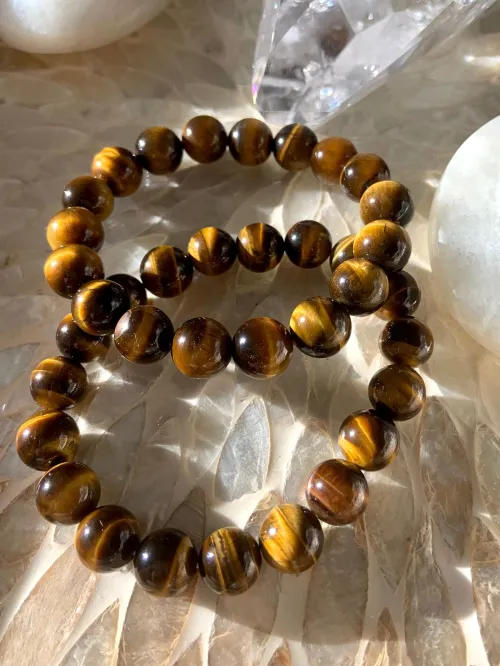
Imagine examining two similar pendants in a shop. One reflects light in fluid stripes that slide across the surface when tilted—the other has static streaks. Here begins your authentication journey through tiger's eye's visual language. These observable traits serve as your personal verification toolkit when encountering unfamiliar stones.
Authentic chatoyancy displays a bright, mobile band perpendicular to the mineral fibers when rotated under light. Try this: Hold the stone near a lamp and tilt it slowly. The luminous stripe should glide cohesively like a ribbon—a characteristic rarely replicated convincingly in synthetics.
Before paying for that necklace, consider simple physics: Plastic or resin fakes feel unnaturally light compared to quartz-based minerals. A quick cheek test adds clues—genuine stones absorb body heat slower than glass imitations due to differing thermal conductivity. These everyday diagnostics may save from costly missteps.
A traveler once documented Roman soldiers sewing tiger's eye chips into battle garments before major campaigns. This archaeological snippet reveals how cultures transformed geological properties into symbolic armor. Let's traverse history from warrior talismans to modern workshops, separating documented traditions from mystical claims while respecting cultural contexts.
Roman military used it as protective amulets against unforeseen attacks, believing the shifting bands represented watchful eyes. Simultaneously, Eastern healing traditions incorporated it into practices focused on mental clarity—a function rooted more in observable experience than spiritual claims. Modern jewelry applications often nod to these dual roots of protection and focus.
The warm spectrum—from champagne golds to rusted ambers—often linked to earth vitality across cultures. Historical texts reveal artisans favoring South African material for its solar brilliance versus Burmese deposits with deeper terrestrial tones. These regional palettes evolved into distinctive symbolic vocabularies, though contemporary users may prioritize aesthetic resonance over traditional meaning.
Picture a jewelry designer handling uncut slabs at a workshop—they prioritize fibrous alignment when angling cuts. This practical moment reveals key considerations for end users. Understanding structural advantages and limitations ensures your purchased piece maintains beauty through daily encounters.
Cabochon cuts maximize chatoyancy when shaped perpendicular to fibers. Stones set in protective bezels hold more securely than prong settings—especially important for pieces experiencing regular movement like bracelets. Check undersides of finished items: quality cabochons feature polished domes without sharp ridges.
When rare deep-red pieces catch your eye, inquire about regional origins and heat treatments. Reputable sellers typically provide extraction details like South African versus Australian sources. Synthetic alternatives labeled as "simulated" avoid material deception while providing similar aesthetics at accessible points.
Having explored tiger's eye from microscopic fibers to cultural fingerprints, condense this to a mental toolkit: Start identification by tilting under any light source, watching for that signature band movement (always perpendicular to patterns). In stores, compare weight against similarly sized objects—that unexpectedly light pendant suggests resin. Remember that color variations reflect geography more than quality; Australian stones showcase cooler undertones than South Africa's solar warmth. When symbolism interests you, focus on documented historical ties versus spiritual interpretations. Next time you encounter tiger's eye—whether online, in museums, or in neighborhood shops—how will your newfound observations reshape that moment?
Q: How does tiger's eye differ from hawk's eye?
A:Tiger's eye forms when oxidized crocidolite transforms into iron-stained quartz, creating warm golden-brown shades, while hawk's eye features unoxidized blue fibers giving it its namesake cool-toned appearance.
Q: Does artificial lighting affect how tiger's eye looks?
A:Incandescent bulbs often amplify reddish undertones, whereas daylight showcases gold striations more clearly—photographing specimens in both scenarios can reveal treatment indicators.
Q: Can everyday wear damage tiger's eye jewelry?
A:Despite its 6.5-7 hardness, friction against harder surfaces may create scratching; store these pieces in separate pouches from diamonds or harder crystals.
Q: What causes rare blue tiger's eye variations?
A:Blue-grey tones typically indicate incomplete oxidization stages between leopard skin jasper and hawk's eye—valuable mainly to specialized collectors rather than mainstream markets.
Q: Are there sustainability concerns with tiger's eye mining?
A:Commercial deposits usually occur as surface-level geodes in deserts, resulting in minimal subsurface disruption compared to deeper mineral extraction; seek documentation for reassurance.
Academic mineralogy reference texts
Peer-reviewed geology research databases
Institutional gemology course materials
National geological survey publications


$
